

A Complete Guide on Developing an Online Marketplace App like Etsy
Quick Summary :
Building a marketplace like Etsy requires meticulous planning. From understanding Etsy’s business model and planning your tech stack to launching the marketplace in a local market and scaling as you gain traction, along with marketing strategies, it’s a staged process. Understand the features to prioritize, how much it costs, and how to build a high-performing, scalable multi-vendor app that rivals industry leaders.Etsy has over 95.5 million active buyers and 8.13 million sellers. Together, they generate $2.80 billion in revenue, which will only grow. Not only will Etsy’s revenue share increase, but the concept of an online marketplace is flourishing.
This brings us to today’s topic, online marketplace app development like Etsy. If you do everything right, you can have a better marketplace app in 2025 than Etsy. Moving from the planning stage to deployment and continuous maintenance, this guide will help you understand how to build a marketplace app that rocks the industry.
Etsy Marketplace Model | Decoded
Before knowing how to develop an online marketplace app like Etsy, let’s understand its business model. Etsy connects individual sellers to a global customer base as a multi-vendor marketplace.
As you plan to replicate this model, the marketplace app development service shall be built around three key user roles;
- Buyers: They browse listings, add items to a cart, make purchases, and leave reviews.
- Sellers: These users manage their storefronts, upload product listings, handle customer inquiries, and fulfil orders.
- Admins: As the platform owner, you manage user accounts, oversee transactions, handle disputes, and ensure smooth platform operations.
Now, as for the revenue generation in a peer-to-peer marketplace development like Etsy, you can choose any one or a combination of the following;
- Commission Fees: A percentage of each sale (like Etsy’s 5% transaction fee).
- Listing Fees: Charge sellers to list their products.
- Subscription Plans: Offer tiered features based on a monthly fee.
- Promoted Listings/Ads: Allow sellers to boost visibility for a fee.
Based on the above information, take time to decide on the marketplace’s structure. This will help you choose the right marketplace app development company and ensure your vision aligns with their capabilities and work experience.
Start building with Experts who understand online marketplaces
Step-by-Step Guide To Build a Marketplace App in 2025
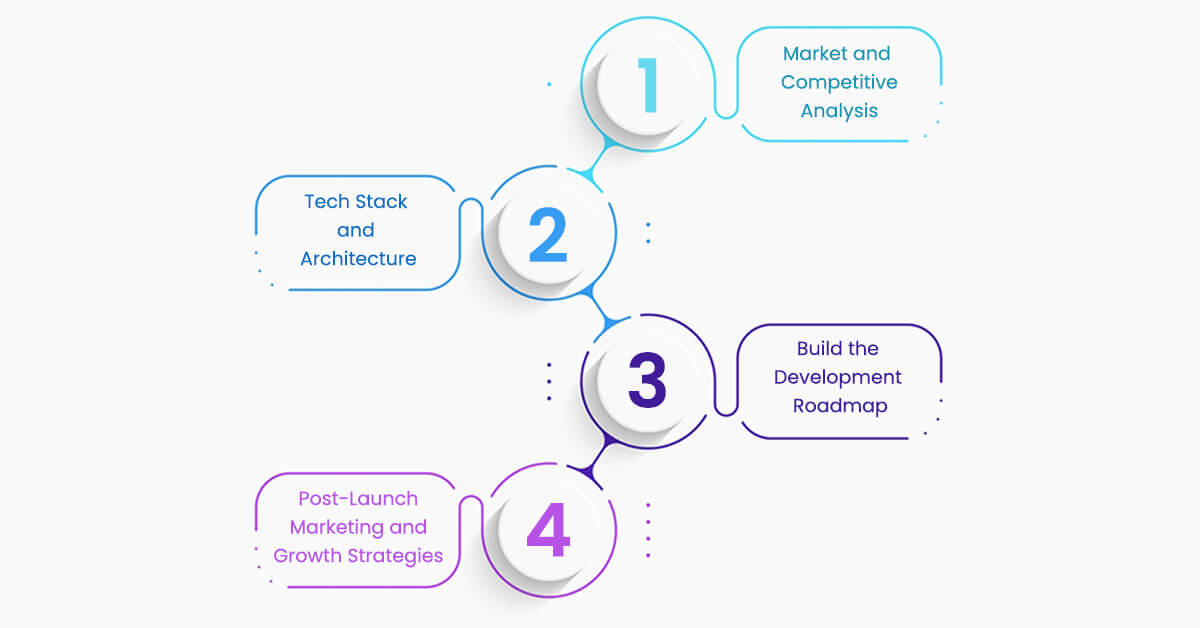
Every step to build a marketplace app is essential to building a user-friendly and market-ready platform.
1. Market and Competitive Analysis
Start by asking the most essential question: Who is your marketplace for, and what can I add to make it unique?
As you dive deep into market and competitor analysis, answer the following;
- Find your niche: Instead of going head-to-head with Etsy, explore other marketplaces in a similar model. For instance, you can explore handmade jewelry, eco-friendly products, vintage collectibles, etc.
- Identify gaps in user experience: Are competitors missing features like real-time chat, multi-currency support, or personalized dashboards?
- Define your USP: Whether it’s faster shipping, exclusive products, or creator incentives, know what sets your platform apart from the competition.
Conducting this analysis early helps you build something your audience wants, not just a mirror image of Etsy.
2. Tech Stack and Architecture
The right technology stack and architecture is not a performance-based decision. It’s more about scalability, online marketplace app development cost, and the convenience of future updates.
Here’s the ideal tech stack for online B2B marketplace development;
Frontend Development
- React.js or Vue.js for the web interface
- React Native or Flutter for cross-platform mobile apps
Backend Development
- Node.js, Django, or Laravel for scalable, secure backend logic.
- RESTful or GraphQL APIs are used to connect the frontend, backend, and third-party services.
Database
- PostgreSQL or MongoDB for user/product data
- Elasticsearch for fast product searches and filters
Cloud Technology and Hosting
- AWS, Google Cloud, or Azure
- Firebase or OneSignal for real-time push notifications
Payment Integration
- Stripe
- Razorpay
- PayPal
- ACH
- Credit/Debit Cards
3. Build the Development Roadmap
The most crucial part of creating a marketplace is the development roadmap. Whether you are building an online rental marketplace like Airbnb or a real estate marketplace like Truila, the roadmap is essential.
- Requirement Analysis: Whether hiring a marketplace app development company or curating an in-house team, ensure you gather all requirements to map out the following;
- Your core audience
- Essential features
- Design references
- Monetization strategy
- UI/UX Design: Create the wireframe of the marketplace’s interface while creating the user flow. In the design wireframing, focus on intuitive navigation and building a visually appealing.
- MVP Development: Build a minimum viable product with the most important features:
- Buyer & seller login
- Product listing &
- checkout
- Basic admin
- dashboard
Creating the MVP is crucial as it lets you test the waters first before investing much money in creating a full-scale application.
- App Testing and Quality Assurance: If your platform has issues, you cannot succeed in the multi-vendor marketplace business. To ensure you don’t end up at the bottom of the market, ensure your marketplace passes the following tests;
- Unit Testing (individual components)
- Integration Testing (across modules)
- Beta Testing with early users
- Performance testing
- Load testing
- Security testing
- Launch Marketplace and Deployment: Deploy your online marketplace on the Play Store, App Store, and live servers. Before publishing the application, ensure all performance, payment, and user flow tests are passed.
Consider two things for Etsy’s marketplace app development. First, use agile development cycles, which means building the app in sprints and integrating customer feedback as you move forward. Second, when creating the application with a solid development plan, you will make it faster and a more innovative product.
4. Post-Launch Marketing and Growth Strategies
If you want to build a product that stays on the popularity meter, don’t stop innovating, adding, and improving. With every version released, your product has to solve customer problems.
- App Maintenance: Regularly fix bugs, update third-party APIs, and improve app performance. Plus, set up a support system for both buyers and sellers.
- Feature Roadmap: Depending on user requirements, continue adding more features to the marketplace. Whether adding in-app messaging, loyalty programs, multilingual support, chatbots, etc., ensure that your customers need these features.
- Growth and Marketing Strategy: Run marketing campaigns and optimization for your marketplace, focusing on the following aspects;
- SEO optimization: Search engine visibility ensures each seller page can be a traffic magnet, but only if optimized correctly. Among the most popular strategies are letting your sellers create customized shop or brand URLs.
- Build SEO best practices, optimizing product titles and descriptions with relevant long-tail keywords. Also, ensure your sellers add meta descriptions and titles to their product pages.
- Social Media Marketing: Leverage social media marketing to build brand identity and tap into communities aligned with your niche. Work on platforms like Instagram, YouTube, TikTok, Facebook, etc., to share content and build your brand recognition.
- Referral Programs: Referrals remain one of the most cost-effective ways to grow your user base. In a marketplace, you can use incentives to reward the person signing up and inviting the new user.
- Work with Influencers: Micro creators are best for startup e-commerce marketplace solutions, as they can collaborate on a lower budget. Influencers have trusted voices and loyal communities. They have higher engagement and ensure your product or solution reaches more targeted audiences.
Features for On-demand Marketplace App
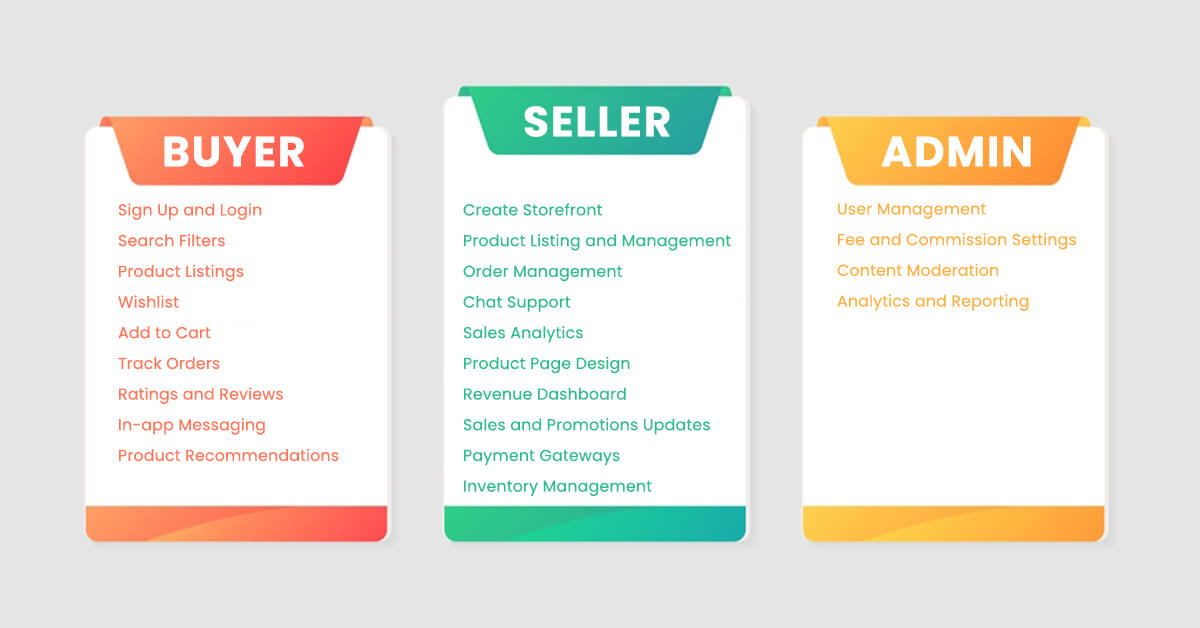
For an on-demand marketplace app there are different roles to consider, including buyer, seller, and admin.
| Buyer | Seller | Admin |
|---|---|---|
| Sign Up and Login | Create Storefront | User Management |
| Search Filters | Product Listing and Management | Fee and Commission Settings |
| Product Listings | Order Management | Content Moderation |
| Wishlist | Chat Support | Analytics and Reporting |
| Add to Cart | Sales Analytics | |
| Track Orders | Product Page Design | |
| Ratings and Reviews | Revenue Dashboard | |
| In-app Messaging | Sales and Promotions Updates | |
| Product Recommendations | Payment Gateways | |
| Inventory Management |
The set of marketplace app features you add can differ according to the product level of the multi-vendor marketplace. For an MVP, you will need only the basic features, leaving advanced features like product recommendations and in-app messaging for later.
Ideally, start by building a basic version of a multi-vendor marketplace platform. As you gain traction, add more features to the platform and expand according to user feedback.
Ready to build your MVP marketplace app?
Market App Development Cost
The cost of developing an online marketplace app like Etsy depends on several factors. These include the complexity of features, technology stack, design requirements, and the development team’s location or rates.
Development Stage | Estimated Cost (USD) |
UI/UX Design | $5,000 – $10,000 |
Frontend & Backend Dev | $20,000 – $50,000+ |
Mobile App Development | $15,000 – $30,000 (iOS + Android) |
Admin Panel Development | $5,000 – $10,000 |
QA Testing & Launch | $3,000 – $7,000 |
Total (Basic MVP) | $40,000 – $60,000 |
Advanced Version | $80,000 – $150,000+ |
Before building the advanced version, you must move ahead with the MVP version first. Even with the MVP, costs can vary depending on the number of features, design complexity, scalability, cloud infrastructure, and ongoing maintenance requirements.
Rest assured that Apps on Demand offers flexible pricing models. From fixed-cost MVP development to full-scale agile builds, we ensure you only pay for what aligns with your business goals.
Conclusion
Developing an online marketplace like Etsy is a complex but rewarding venture if you do everything right. Every step matters from understanding your niche to assembling the right tech stack and launching a refined MVP.
If you’re ready to turn your idea into a scalable online marketplace, Apps on Demand can guide you from blueprint to reality. Our online B2B marketplace development team specializes in end-to-end custom marketplace development that is aligned with your business vision.