

Quick Summary :
- Handyman app development starts with building a strong foundation, focusing on the right features, scalable architecture, and real user needs.
- A successful on-demand handyman app balances customer-side and handyman-side to ensure smooth bookings, efficient service delivery, and full platform control.
- Handyman app development cost depends on app complexity, scalability requirements, and whether you’re building a simple booking app or a full handyman marketplace app.
- Working with the right handyman app development company helps avoid common mistakes, plan scalability early, and build a reliable on-demand service platform that’s ready to grow.
People no longer search endlessly or wait for referrals when something breaks; they reach for their phones and expect a quick, reliable solution. And if your handyman business isn’t visible in that moment, it’s not just missing clicks, it’s missing real opportunities to connect, help, and grow.
Your customers don’t want to make calls, wait for callbacks, or juggle schedules. They want a solution that’s instant, transparent, and reliable. That’s exactly why building a handyman app has become so important. It puts your services right where customers already are, their smartphones, and turns a traditionally offline, fragmented experience into something seamless and predictable.
Drawing from our hands-on experience building scalable on-demand platforms for home service businesses, we’ve seen how the shift toward instant service access is reshaping customer expectations.
The on-demand handyman app market alone was valued at around $4.1 billion in 2023 and is projected to reach about $12.2 billion by 2032 as consumer preference for instant service booking grows.
A well-built handyman app does more than just enable bookings. It builds trust through verified professionals, real-time updates, upfront pricing, and clear communication.
Well, if you are considering on-demand handyman app development and want to understand must-have handyman app features, what the handyman app development cost is, and how to get started with an on-demand handyman app, then this blog is all you need. Let’s get started with it.
What Is a Handyman App?
Handyman app development is about taking everyday repair services and making them easy to access through a mobile app. It involves building a platform where people can book plumbers, electricians, carpenters, or general maintenance professionals without calling multiple numbers or waiting for responses.
Instead of handling everything manually, the app manages bookings, schedules, payments, and communication in one place.
Customers get quick access to the help they need, while service professionals get a structured way to receive jobs and manage their work. In simple terms, a handyman app turns a traditional service model into a digital, on-demand experience that fits how people look for services today.
The Core Benefits of Building a Handyman App
Building an on-demand handyman app isn’t just about keeping up with trends; it’s about solving real problems for both customers and service providers in a way that actually scales. Let’s take a closer look at the core benefits of building a handyman app.
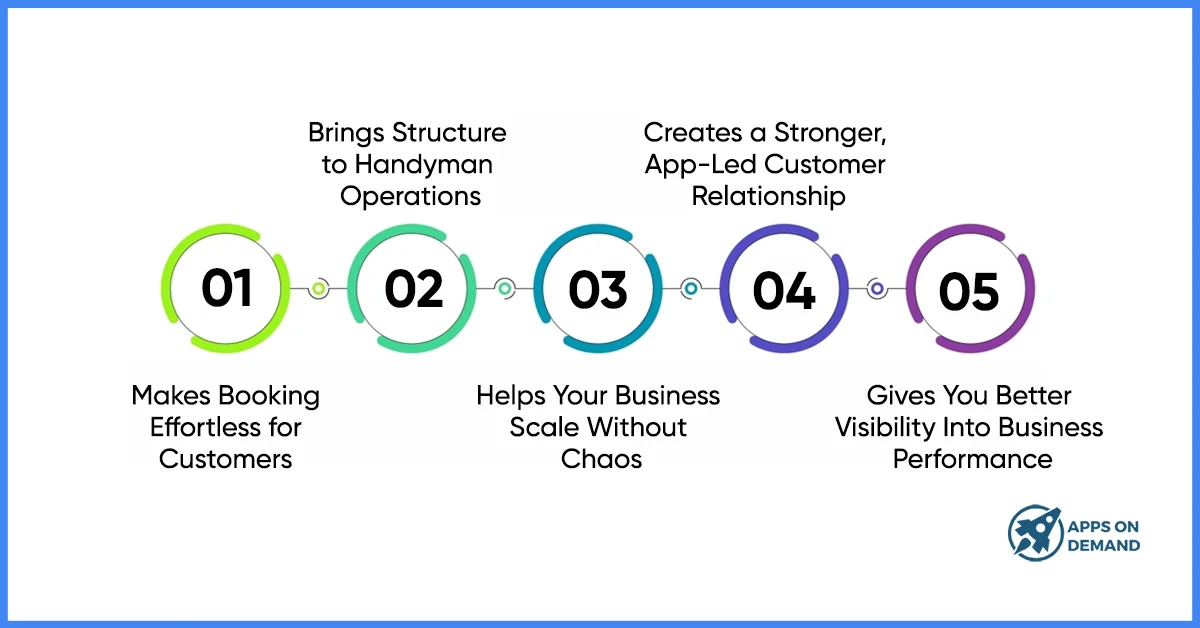
1. Makes Booking Effortless for Customers
One of the biggest wins of a handyman app is how easy it makes life for customers. Instead of calling around, explaining the same issue multiple times, or waiting for callbacks, users can simply open the app, select the service they need, choose a time slot, and confirm the booking.
That ease of use removes friction, and when booking feels effortless, customers are far more likely to return.
2. Brings Structure to Handyman Operations
For handymen and service providers, a handyman booking app replaces scattered messages, manual scheduling, and guesswork with a clear, organized system. Jobs come into one place, schedules stay structured, and payments are tracked automatically.
This structure helps professionals focus on their work instead of coordination, while businesses gain better control over service quality, availability, and performance.
3. Helps Your Business Scale Without Chaos
As demand grows, managing services manually becomes unsustainable. An on-demand handyman app supports growth by automating core workflows, including bookings, assignments, and payments.
Whether you’re handling 10 service requests a day or 1,000, the platform ensures consistency and reliability, allowing your business to grow without adding operational complexity.
4. Creates a Stronger, App-Led Customer Relationship
A handyman app keeps your brand directly connected to customers. Instead of relying solely on third-party platforms or referrals, your business owns the customer experience from booking to payment to post-service follow-ups.
This direct relationship leads to repeat bookings, higher customer lifetime value, and stronger long-term returns on your app investment.
5. Gives You Better Visibility Into Business Performance
A handyman app doesn’t just manage bookings; it shows you what’s actually happening across your business. From service demand and peak booking times to provider performance and revenue trends, everything becomes measurable.
This visibility helps businesses make smarter decisions, optimize resources, and plan growth using real data instead of guesswork.
Must-Have Features for Handyman App Development
Customer Focused Features:
When building a handyman app like Uber, getting the core features right is what sets the foundation for everything that follows. So, here are some of the must-have features in your on-demand handyman app. Let’s get started.
1. Easy Service Selection and Booking
This is where the entire user journey begins. Customers should be able to open the app, choose the service they need, and book it without thinking twice. A clean, simple booking flow reduces drop-offs and makes first-time users feel confident.
Here’s what you should include:
- Clear service categories (plumbing, electrical, carpentry, etc.)
- Simple job description and booking form
- Date and time slot selection
- Instant booking confirmation
2. Real-Time Availability and Scheduling
Another crucial handyman app feature includes real-time scheduling that removes uncertainty for both customers and service providers. Users see available time slots upfront, while businesses avoid overbooking and scheduling conflicts.
Here’s what you should include:
- Live availability of service providers
- Automatic schedule updates
- Conflict-free job assignments
- Better workload management
3. Service Provider Profiles and Verification
Trust plays a huge role in handyman services. So, make sure to include a detailed and verified provider profile section that helps customers make informed decisions and feel comfortable inviting professionals into their homes.
Here’s what you should include:
- Profiles with skills, experience, and services offered
- Ratings and customer reviews
- Identity and background verification
- Service history visibility
4. In-App Payments and Billing
A handyman app should make payments as simple as booking a service. Built-in payments remove the need for cash handling, follow-up calls, or manual invoices, creating a smoother experience for everyone involved.
Here’s what you should include:
- Multiple secure payment options
- Transparent pricing before confirmation
- Automatic invoice generation
- Easy payout tracking for service providers
5. Real-Time Job Tracking and Status Updates
Customers want to know what’s happening once they book a service, and this is where real-time job tracking and status updates come in. The handyman app features keep them informed and reduce unnecessary calls or messages.
Here’s what you should include:
- Live job status updates (confirmed, on the way, completed)
- Arrival and completion notifications
- Better communication between customers and providers
- Improved service transparency
6. Ratings, Reviews, and Feedback System
Feedback is essential for maintaining service quality at scale. A built-in review system helps customers share their experience and helps businesses monitor performance. Also, it helps other customers in getting to know each other’s experience and make the right decision.
Here’s what you should include:
- Post-service ratings and written reviews
- Quality control through feedback tracking
- Provider performance visibility
- Increased trust for new users
7. Admin Dashboard for Complete Platform Control
An admin dashboard is the control center of your handyman app. It allows businesses to monitor bookings, manage users, and keep daily operations running smoothly.
Here’s what you should include:
- Centralized view of all bookings and services
- User and service provider management
- Pricing, commissions, and service category control
- Access to reports and basic analytics
8. Service Area and Location Management
Location plays a big role in on-demand services app. This handyman app feature ensures customers are matched with nearby professionals and services stay efficient.
Here’s what you should include:
- Location-based service availability
- Smart provider assignment by area
- Reduced travel time and delays
- Better service coverage planning
9. Customer Support and In-App Communication
Even with automation, support matters. In-app communication helps resolve issues faster and keeps the experience smooth.
Here’s what you should include:
- In-app chat or call options
- Booking-related queries and updates
- Faster issue resolution
- Reduced dependency on external communication tools
Handyman Focused Features
After covering customer-side features, the next step is focusing on what matters most to the people actually delivering the service. A handyman app should make their day easier, not more complicated. The right features help handymen manage jobs, time, and earnings smoothly, so they can focus on the work, not the admin.
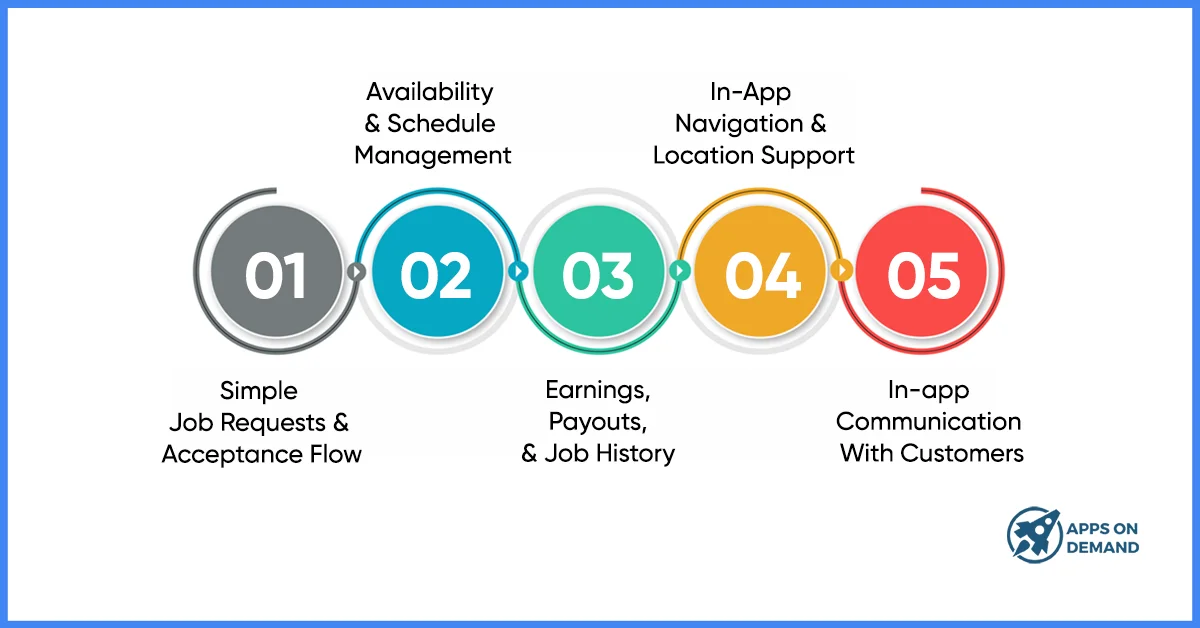
1. Simple Job Requests and Acceptance Flow
Handymen need clarity, not clutter. When a new job comes in, they should be able to see the job details and accept or decline it quickly. A clean job request flow helps them make faster decisions and reduces missed opportunities.
Here’s what you should include:
- Clear job details (service type, location, time, payment)
- Accept or reject the option with a single tap
- Real-time job notifications
- Reduced back-and-forth with customers
2. Availability and Schedule Management
Handymen often juggle multiple jobs and personal commitments. Giving them control over their availability helps prevent burnout and scheduling conflicts.
Here’s what you should include:
- Ability to set working hours and days
- Option to mark busy or unavailable slots
- Automatic updates when jobs are accepted
- Better time and workload management
3. Earnings, Payouts, and Job History
Transparency around earnings builds trust with the platform. Handymen should always know how much they’re earning and when they’ll get paid.
Here’s what you should include:
- Clear earnings breakdown per job
- Payout status and payment history
- Downloadable invoices or summaries
- Better financial visibility and confidence
4. In-App Navigation and Location Support
Handymen shouldn’t have to switch between multiple apps just to reach a job. Built-in navigation helps them get to service locations faster and on time.
Here’s what you should include:
- Integrated maps and directions
- Customer location details and notes
- Reduced travel confusion and delays
- Better on-time arrival rates
5. In-app Communication With Customers
Clear communication helps handymen do their job better. Instead of calling or switching between apps, in-app communication keeps all job-related conversations in one place and avoids misunderstandings.
Here’s what you should include:
- In-app chat or call options
- Ability to clarify job details before arrival
- Secure, platform-controlled communication
- Reduced confusion and smoother service delivery
Admin Panel Features for Platform Control
The admin panel is where a handyman platform really comes together. While customers book services and handymen complete jobs, the admin dashboard gives businesses full visibility and control over how the on-demand handyman app operates.
Here are the key admin panel features that help keep everything organized, scalable, and efficient.
1. User and Service Provider Management
Admins should be able to manage both customers and handymen from one place. This includes profile approvals, verification, suspensions, roles, etc to maintain quality in handyman service app development.
2. Booking and Job Oversight
A centralized booking view allows admins to track all service requests in real time. From active jobs to completed ones, this feature helps resolve issues quickly and keeps the handyman booking app running smoothly.
3. Service and Category Management
Admins need control over the services offered on the platform. This includes adding or updating service categories, setting availability by location, managing pricing rules, etc, to scale the handyman app, the right way.
4. Pricing, Commissions, and Payments Control
The admin panel should support in-app payments and billing management. Admins can configure service fees, commissions, payouts, and refunds, giving full financial visibility and control.
5. Analytics and Reporting
Built-in reports help businesses understand platform performance. Insights into bookings, revenue, and provider activity support data-driven decisions and reduce guesswork.
6. Location and Service Area Management
Admins can define service zones and match handymen to nearby jobs. This feature improves response times and supports expansion in mobile app development for local services.
7. Dispute and Support Management
When issues arise, the admin panel acts as a resolution hub. Admins can review job details, communication history, and complaints to resolve disputes fairly and quickly.
8. Notifications and Platform Communication
Admins should control platform-wide messages, alerts, and promotions. This helps keep users informed and engaged across the on-demand handyman app.
Technology Considerations for Scalable Development
When you’re building a handyman app with scale in mind, the tech you choose quietly decides how far the platform can go. The goal isn’t to pick the most advanced tools; it’s to choose technologies that won’t slow you down when users, bookings, and service providers start growing.
Here’s how experienced product teams think about it.
1. Start With Cross-Platform, But Don’t Compromise on Performance
If speed to market matters (and it usually does), cross-platform frameworks like Flutter or React Native are smart starting points. They let you launch on both iOS and Android faster without doubling development effort. The key is to pair them with clean architecture and performance optimization so your on-demand handyman app still feels smooth as usage increases.
2. Choose a Backend That Can Grow Without Drama
Your backend is where scalability really lives. Tools like Node.js, Django, or Spring Boot work well for handyman service app development because they handle real-time requests, scheduling logic, and user activity efficiently. Pair this with a microservices or modular architecture, and you’ll thank yourself later when you add new services or expand into new locations.
3. Use Cloud Services, Not Fixed Infrastructure
Scalable apps don’t live on fixed servers. Cloud platforms like AWS, Google Cloud, or Azure let your handyman booking app scale automatically during peak demand, weekends, emergencies, or seasonal spikes. They also simplify backups, monitoring, and deployment, so your team focuses on product growth instead of server maintenance.
4. Be Smart With Databases From Day One
For on-demand service platforms, a mix often works best.
- Use relational databases (like PostgreSQL or MySQL) for bookings, payments, and transactions.
- Use NoSQL databases (like MongoDB or Firebase) for real-time data such as chat, notifications, or live job status.
This balance keeps your app fast while handling complex workflows.
5. Don’t Overbuild Payments, Integrate Wisely
Payments are critical, but they don’t need to be custom-built. Trusted gateways like Stripe, Razorpay, or PayPal handle security, compliance, and scale far better than in-house solutions. This makes in-app payments and billing reliable and future-ready without unnecessarily increasing the handyman app development cost.
6. Design APIs Like You’ll Need Them Tomorrow
Even if you don’t need every integration today, design your APIs as if you will. Maps, CRM tools, analytics platforms, customer support software, and API-first thinking make future expansion smoother. This is especially important if you plan to build a handyman marketplace app or add partner integrations later.
7. Think Long-Term About Maintenance, Not Just Launch
The best tech stack is one that your team or an experienced handyman app development company can easily maintain. Popular, well-documented tools reduce hiring challenges, lower long-term costs, and keep updates predictable. Scalability isn’t just about traffic; it’s about how easily your product evolves.
Something you should know: To design a scalable handyman app, development isn’t about chasing trends. It’s about choosing tools that support growth quietly, reliably, and without forcing painful rebuilds later. Build smart now, and scaling becomes a natural next step, not a technical hurdle.
Common Handyman App Development Mistakes
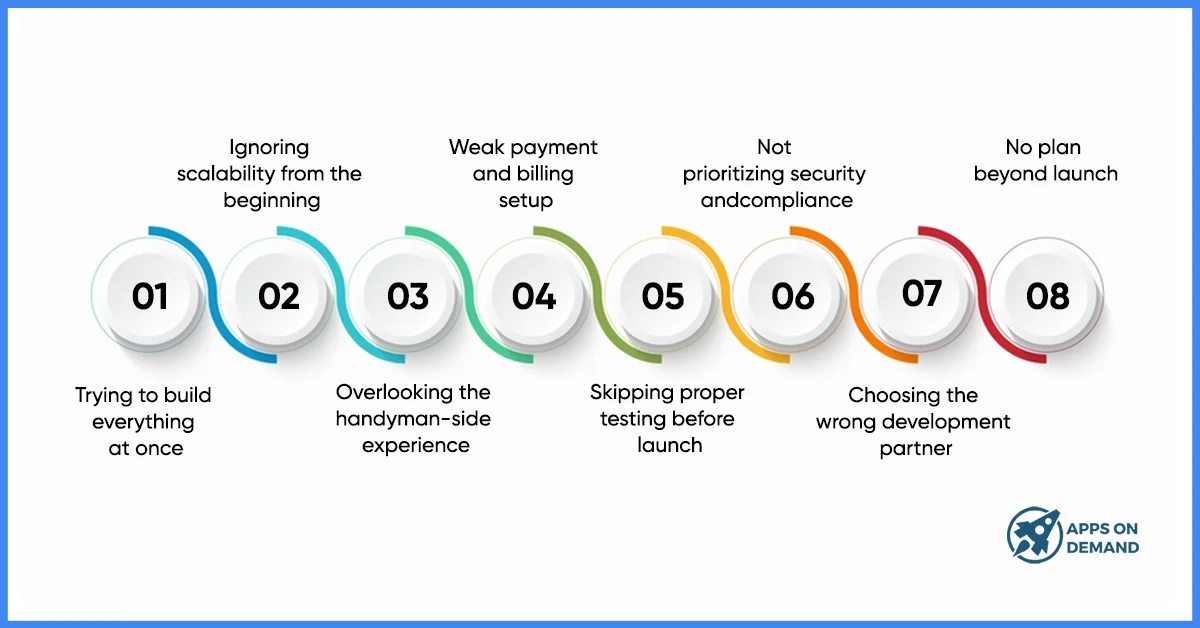
1. Trying to build everything at once
Packing too many handyman app features into the first version often slows development, delays launch, and increases handyman app development cost without delivering real value to users.
2. Ignoring scalability from the beginning
Building without scalability in mind can lead to performance issues as bookings and users grow, forcing expensive rework later and slowing business expansion.
3. Overlooking the handyman-side experience
When a handyman service app development focuses only on customers, service providers struggle with poor workflows, which affects job acceptance, service quality, and overall platform reliability.
4. Weak payment and billing setup
Incomplete in-app payments and billing systems create confusion, delays, and disputes, directly impacting user trust and smooth platform operations.
5. Skipping proper testing before launch
Launching a handyman booking app without thorough testing often results in bugs, crashes, and negative reviews that are hard to recover from early on.
6. Not prioritizing security and compliance
Ignoring data security and compliance puts user information and transactions at risk, leading to trust issues and higher long-term costs to fix vulnerabilities.
7. Choosing the wrong development partner
Working with a team that lacks experience in on-demand service platforms can cause misaligned features, unclear timelines, and unnecessary increases in handyman app development cost.
8. No plan beyond launch
Treating launch as the endpoint instead of the starting point leads to outdated features, poor user retention, and limited growth for the on-demand handyman app.
Handyman App Development Cost by Feature
The cost of building a handyman app mainly depends on how complex you want the platform to be. Here’s everything you need to know about the development costs and what they include:
| Points of Difference | Basic Handyman App | Standard Handyman App | Advanced Handyman App |
| Booking Experience | Simple booking with limited options | Real-time booking with live availability | Smart booking with automation and dynamic workflows |
| Service Scope | Limited services and categories | Multiple services with structured categories | Wide service range with flexible, customizable offerings |
| Scheduling Logic | Fixed or manual time slots | Live scheduling with conflict prevention | Intelligent scheduling with auto-assignment |
| Service Provider Management | Basic provider profiles | Verified profiles with ratings and reviews | Advanced onboarding, tracking, and performance insights |
| Payments & Billing | Manual or limited digital payments | Secure in-app payments and invoices | Automated payouts, commissions, and billing rules |
| Admin Control | Basic admin access | Centralized admin dashboard | Advanced admin panel with deep operational control |
| Customer Experience | Functional and straightforward | Smooth and user-friendly | Highly personalized and seamless |
| Scalability | Suitable for small operations | Designed for growing businesses | Built for large-scale, multi-location expansion |
| Data & Reporting | Minimal or manual reporting | Standard dashboards and reports | Advanced analytics and business insights |
| Customization & Integrations | Very limited customization | Moderate customization options | Fully custom workflows with API integrations |
| Total Cost | $25,000 – $45,000 | $45,000 – $80,000 | $80,000 – $150,000+ |
If you’re just entering the market, a basic handyman booking app helps you validate demand quickly. A standard on-demand handyman app is ideal for businesses ready to scale operations digitally. And if your goal is to build a handyman marketplace app, the higher investment supports long-term growth, flexibility, and expansion.
Choosing the Right Handyman App Development Company
Building a successful on-demand handyman app isn’t just about features; it’s about who builds it with you. The right handyman app development company helps you make smarter decisions, avoid costly mistakes, and build a platform that’s ready to scale.
Here’s how to choose a development partner that actually supports your business goals.
1. Experience with on-demand service platforms
Look for a handyman app development company that understands how on-demand service platforms work. Experience with on-demand handyman apps helps ensure smooth booking flows, real-time scheduling, and reliable service management from day one.
2. Strong understanding of handyman app features
The right team should clearly explain which handyman app features are essential for launch and which can be added later. This helps you avoid overbuilding and keeps the handyman service app development focused and efficient.
3. Support for custom and scalable development
Choose a partner that offers custom handyman app development and designs the platform to scale. This is especially important if you plan to grow into a handyman marketplace app or add more services and locations over time.
4. Clear breakdown of the handyman app development cost
A trustworthy company will be transparent about the handyman app development cost, including what’s included in each phase and how feature additions impact the budget and timeline.
5. Experience with integrations and payments
Make sure the team can handle in-app payments and billing, API integrations, and other tools needed for a smooth handyman booking app experience.
6. Post-launch support and long-term collaboration
Mobile app development for local services doesn’t end at launch. Choose a handyman app development company that offers ongoing support, updates, and improvements as your on-demand handyman app grows.
Conclusion
By now, one thing should be clear: building a handyman service app isn’t just a tech decision; it’s a business move. The difference between an app that struggles and one that scales comes down to clarity: choosing the right features, planning for growth early, and avoiding shortcuts that cost more later.
And, in order to do that effectively, you need the right partner to help you with the on-demand app development services.
If you’re ready to move from planning to execution, our team at Apps On Demand, as a leading Handyman app development company, can help. We help businesses turn service ideas into high-performing, scalable on-demand platforms, built with real-world usage, growth, and long-term success in mind.
Ready to get started with the right strategy, the right technology, and a team that understands on-demand service businesses? Book a free consultation call with our experts right away.