

Quick Summary :
Discover how to build a fitness app from scratch that engages users, tracks progress, and drives results. This guide explores market validation, feature prioritization, UI/UX design, development strategies, and launch planning, providing actionable insights to create a standout, user-focused app. Learn how to turn your fitness app idea into a functional, scalable, and successful digital product.
The “urge to stay fit” has picked up pace in the last few years due to the global movement towards staying healthy. Technology has only helped in this movement where we now have connected wearables to on-demand workout platforms ensuring fitness is not limited to gyms.
Between 2024 and 2030, the fitness application market is expected to reach a valuation of $25.8 billion. But this should not be the sole reason for you to create a fitness app.
At the same time, with thousands of fitness apps already in the market, building yet another calorie tracker or workout timer won’t cut it. The real challenge isn’t just to create a fitness app, it’s building one that stands out, engages users, and sustains growth. Here’s a fitness app development guide you need to follow.
What is Fitness App Development?
Fitness app development is the end-to-end process including designing, coding, and launching an application for the web or mobile devices. Such applications or software are used by people to improve their physical and mental health along with ensuring overall wellbeing.
Fitness applications are built to motivate users to stay fit, help them track their fitness regime, follow a path to better health, and achieve their fitness goals.
In this exercise, we help our clients ideate and build the best solution through our on demand app development expertise. We believe fitness isn’t only about translating human wellness needs, but it’s more about creating a sense of self-satisfaction, self-esteem, and a way to build a disciplined lifestyle.
Key Considerations of Fitness App Development Services
To build the best fitness application, we recommend our clients to follow these four steps;
- Know Your Audience: Understand your users, their needs, wants, and aim to use a fitness app. Identify what motivates them to use fitness apps, their approach to fitness, ability to build a fitness routine, and more.
- Accessibility and Performance: Build a fitness app with assured performance on all devices and platforms whether its iOS, Android, desktop, tablet, or mobile.
- Variety of Content: Instead of sticking to a single format, offer classes, courses, knowledge, etc. in different formats. From videos, to audio lessons to images, to downloadable guides, ensure your users feel comfortable in accessing the content they want how they want.
- Plans to Retain Users: Always integrate ways to retain your users and ensure they keep on using the application. Whether it’s through gamified retention features or by giving freebies, find out how you can retain your users.
The Main Types of Fitness and Workout Apps
To ensure your fitness application doesn’t get lost in an already saturated market, you need to make a smart choice and find your differentiation. The global app stores are flooded with fitness products that do almost the same thing, isn’t it?
So you need to be different and choose a segment where your expertise, technology, and approach gives your users something new and gives you “an edge over competitors.”
| Type of Fitness App | Core Aspects | Why It’s Different |
|
Workout & Training Apps |
Offer exercise libraries, personalized workout plans, video tutorials, and progress tracking. |
Focus on adaptive training where AI-based recommendations evolve with user performance. Also, integrate wearables for real-time feedback. |
|
Activity Tracking Apps |
Monitor steps, calories, sleep, heart rate, and other metrics via sensors or integrations with wearable devices and smart watches. |
To be different, go beyond basic tracking and let your users visualize insights and patterns that help users act on data, not just collect it. |
|
Nutrition & Diet Apps |
Help users track meals, calories, and other relevant macros. Within the app, offer meal planning and recipe suggestions. |
Add behavioral coaching or integrate with grocery app APIs for real-time ingredient tracking and delivery. |
|
Meditation & Mindfulness Apps |
Focus on mental well-being through guided meditations, breathing exercises, and stress tracking. |
Blend physical and mental wellness as the users may pair workouts with mindfulness routines or recovery sessions. |
|
Yoga & Pilates Apps |
Provide video-guided sessions, asana (pose) image & video, and personalized plans for flexibility and strength. |
Create immersive instruction using AR/VR to help users perfect their form remotely. |
|
Social Fitness & Challenge Apps |
Let users join communities, set challenges, and compete or collaborate with friends. |
Combine gamification with community building with reward distribution celebrating achievements and not just performance. |
|
Fitness Coaching & Personal Trainer Apps |
Connect users with certified trainers for live or asynchronous coaching sessions. |
Offer hybrid coaching models combining AI-based plan generation with human trainer feedback. |
|
Wearable Integrated Apps |
Sync with smartwatches, heart-rate monitors, and fitness bands to provide continuous data-driven insights. |
Focus on multi-device integration and real-time data dashboards that adapt to individual goals. |
|
Holistic Health & Wellness Apps |
Combine fitness, nutrition, sleep, and mental health tracking for overall well-being. |
Create your differentiation through personalization algorithms and lifestyle-based goal setting, not just metrics. |
|
Corporate Wellness Apps |
Designed for teams and organizations to promote health engagement and productivity. |
Add gamified leaderboards, incentives, and team-based wellness challenges to boost participation. |
Key Features of Custom Fitness App Development
The right set of features will set your fitness application apart from the competition. When developing a fitness app for Anroid or iOS, apart from the essential features, focus on different mobile application ideas and applications as these unique functionalities will help create an engaging experience.
Must-Have Features for Fitness App Development
- Onboarding: A smooth signup process introducing users to the app, collecting basic info, and setting initial fitness goals.
- User Profile: A personalized space storing user details, preferences, fitness level, and activity history for tailored experiences.
- Exercise Libraries: A collection of exercises with videos, images, and instructions, enabling users to follow workouts correctly and safely.
- Goal Setting: Allows users to define fitness targets such as weight loss, strength, endurance, or consistency, fostering motivation.
- Activity or Progress Tracking: Tracks steps, workouts, calories, and other metrics, providing visual summaries of user progress over time.
- Social Interaction: Enables connecting with friends or other users, sharing progress, encouragement, or participating in challenges.
- Community Sharing: Users can share achievements, workouts, and experiences within app communities to enhance engagement and motivation.
- Push Notifications: Reminders for workouts, goal achievements, or motivational messages to keep users engaged and consistent.
- Gamification: Incorporates streaks, badges, and rewards to encourage regular use and reinforce positive fitness habits.
- Customizable Workout Plans: Users can personalize workout schedules based on goals, skill level, or preferred intensity for better adherence.
Advanced Features for Fitness App Development
- Personalized Recommendations: AI-driven suggestions for workouts, nutrition, or routines tailored to individual progress, goals, and preferences.
- Adaptive Workout Plans: Plans dynamically adjust intensity and type based on user performance, feedback, and physiological data.
- Meal Logging: Track meals, calories, and macros, providing insights into nutrition habits and dietary goals.
- Recovery Monitoring: Tracks rest, muscle recovery, and fatigue to optimize workout schedules and prevent overtraining.
- Stress Tracking: Monitors mental and emotional wellness using surveys, wearable sensors, or activity patterns to suggest coping strategies.
- Health Monitoring: Integrates wearable or device data to track heart rate, sleep, activity, and overall wellness metrics for insights.
Step-by-Step Process for Fitness App Development
Custom fitness app development is simple, yes you read it right, it’s simple. But only if you follow the right approach and choose the right team. Going forward, we will share the key steps followed at Apps On Demand for fitness app development.
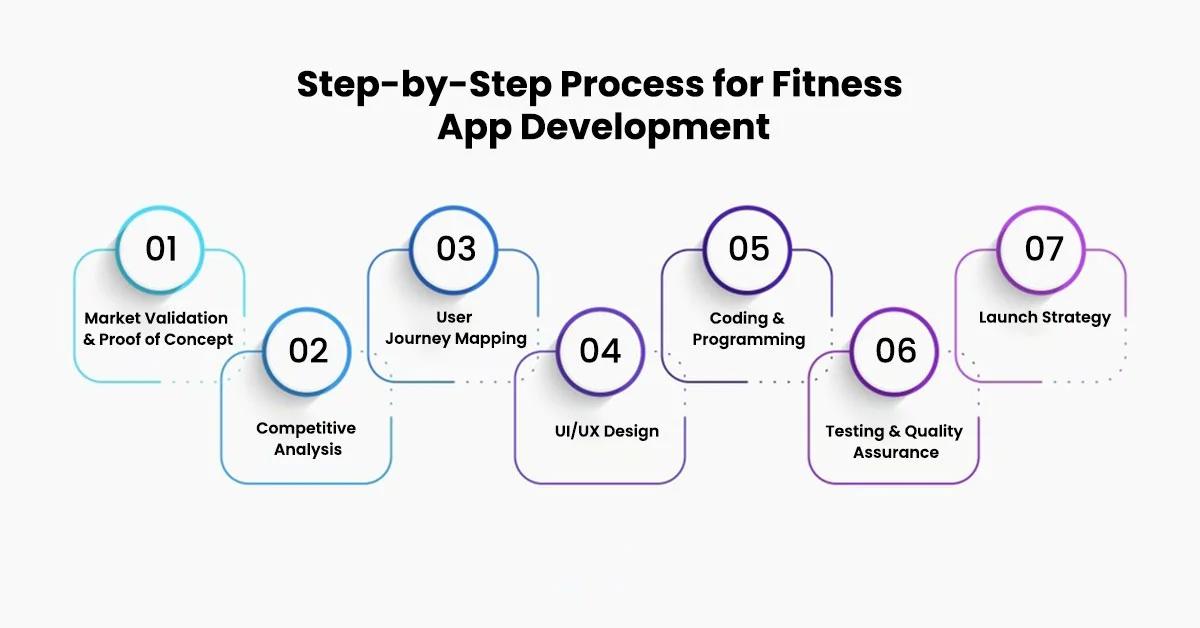
1. Market Validation and Proof of Concept
Before everything else, know whether your application idea is fit for the market. Validate your concept by assessing real user demand and feasibility. To know whether your ideal can pick up speed, conduct surveys, interviews, and competitor benchmarking only to build a proof of concept.
This is to be sure that your well app development idea has users and a target audience that’s still looking for a solution for their unmet needs, like personalized workouts or nutrition tracking.
- Identify target audience (beginners, fitness enthusiasts, or corporate users).
- Analyze pain points of existing fitness apps.
- Test engagement with core features, not the full suite.
2. Competitive Analysis
The fitness application market is already saturated, especially after the urge to say fit has become a global phenomenon after COVID-19. So to be different first conduct a competitive analysis of your competitors.
Look for their strengths, weaknesses, and gaps only to find opportunities in personalization, gamification, social integration, or wearable connectivity.
- Track which features drive retention (workout reminders, streaks, leaderboards).
- Analyze pricing models (freemium, subscription, in-app purchases).
- Identify underserved niches (home workouts, mental wellness, senior fitness).
3. User Journey Mapping
Map the entire user journey from logging into the application to using it on a daily basis. Create workflows for every feature, function, and action to ensure you can optimize every touchpoint for the highest engagement and retention.
- Onboarding Flow: Goal selection, profile setup, and initial fitness assessment.
- Core Actions: Logging workouts, tracking nutrition, completing challenges.
- Engagement Loops: Notifications, streaks, milestones, and reward systems.
- Feedback Points: Daily summaries, performance insights, or community encouragement.
4. UI/UX Design
Work on a visually appealing yet an intuitive interface that’s easy to understand, accessible, and motivates your users to stick with their fitness routine. If you think that design, however its made doesn’t matter for the user retention, think again.
The top fitness app development company like Apps on Demand pays gives equal attention to the design part as to others. Your focus with fitness app development services design must be to ensure simplicity, clarity, and motivation.
- Use clear, actionable dashboards for workouts, nutrition, and progress.
- Incorporate gamification elements (badges, streaks, achievements).
- Prioritize legibility during workouts large fonts, minimal navigation.
- Make progress visible with charts, goal meters, or daily summaries.
- Mobile-first design is critical; consider smartwatch or wearable integration for instant feedback.
5. Coding and Programming
This is the step where the fitness app developers will transform design and features into a functional and beautiful machine. For this step, you also need to understand the best tech stack for developing a fitness app.
- Mobile Frontend: Native (Swift for iOS, Kotlin for Android) for high performance.
- Cross-platform: Flutter or React Native for faster development.
- Backend: Firebase, Node.js, or microservices for scalability and integration with health APIs.
- Integration: Apple HealthKit, Google Fit, Fitbit, Garmin, or third-party nutrition APIs.
When coding ensure to add the following aspects;
- Ensure offline access for workouts or meal plans.
- Implement data syncing and analytics from wearables in real-time.
- Prioritize security for sensitive health data (GDPR/HIPAA compliance).
6. Testing and Quality Assurance
Testing and quality assurance teams will verify each functionality, check security, remove bugs, and fix performance issues. They will ensure your wellness app development efforts pay off in form of a visually appealing and performant application. Types of testing includes;
- Functional Testing: Workouts, progress tracking, notifications, meal logs.
- Usability Testing: Ensure navigation is intuitive during exercise routines.
- Performance Testing: App speed, battery usage, and load handling.
- Compatibility Testing: Across multiple devices, OS versions, and screen sizes.
- Beta Testing: Collect feedback from early users to refine features and fix bugs.
7. Launch Strategy
To ensure your application run smoothy with wearables also test sensor integration and monitor heart rate, GPS, and accelerometer. Plus make sure to check and verify offline functionality and data synchronization across different connected devices.
Your launch strategy must be based on a pre-built marketing plan. In addition to these, understand the technical details of launching the application and cover the following;
- App Store Optimization (ASO): Optimize title, description, keywords, and screenshots for discoverability.
- Beta Launch: Release to a limited audience to gather feedback and fix issues.
- Marketing & Outreach: Collaborate with fitness influencers, blogs, or gyms; run social campaigns.
- Engagement Plan: Send push notifications, reminders, and highlight challenges or streaks.
- Analytics Setup: Track downloads, retention, active users, and feature engagement to inform future updates.
Following this design, development, and launch strategy for custom fitness app development ensures your fitness app isn’t just functional, but also engaging, differentiated, and scalable.
Fitness App Development Cost Analysis
|
Development Step |
Estimated Cost Range |
Description |
|
Market Validation & PoC |
$5,000 – $15,000 |
Includes market research, user surveys, and developing a proof of concept to validate the app idea. |
|
Competitive Analysis |
$3,000 – $7,000 |
Researching competitors to identify gaps and opportunities in the market. |
|
User Journey Mapping |
$2,000 – $5,000 |
Creating user personas and mapping out the user experience to ensure intuitive app design. |
|
UI/UX Design |
$10,000 – $25,000 |
Designing the app’s interface and user experience for optimal engagement and usability. |
|
Coding & Programming |
$30,000 – $100,000+ |
Developing the app’s frontend and backend, including integration with APIs and third-party services. |
|
Testing & QA |
$5,000 – $15,000 |
Conducting thorough testing to identify and fix bugs, ensuring the app’s reliability and performance. |
|
Launch Strategy |
$5,000 – $10,000 |
Planning and executing the app launch, including marketing and user acquisition strategies. |
Conclusion
To build a fitness application means creating an experience for your users that motivates and engages them to use your application everyday. This means build an application that your users would have to use given the benefits they receive.
From validating your idea and mapping user journeys to designing intuitive interfaces and launching with a solid strategy, every step matters. Even though the fitness application market is already crowded, but there’s always opportunity waiting to be explored.
Focusing on differentiation and personalized, add user-centric features and build a unique application for your target market. At AppsOnDemand.com, we specialize in turning ambitious app concepts into reality. Our on-demand fitness app development expertise spans fitness apps, health tech solutions, and digital engagement platforms, helping you bring your vision to life from MVP to full-featured product.
Ready to build a fitness app that users love and want to use everyday? Let’s make it happen.