

Key Highlights
- On-demand staffing apps help staffing companies respond faster to urgent and last-minute hiring requests.
- Focusing on the right on-demand staffing app features delivers better results than building feature-heavy platforms.
- The right development approach turns an on-demand staffing app into a long-term business asset rather than just a hiring tool.
Staffing in 2026 isn’t about filling roles anymore; it’s about fulfilling talent demand at the right time.
Clients don’t want timelines, follow-ups, or we’ll get back to you. They want people on the floor, on time, and ready to work.
When demand spikes unexpectedly, or shifts change at the last minute, traditional processes simply can’t keep up. That’s where the right on-demand staffing app features start making a real difference. It brings order to the chaos.
Based on our experience building on-demand staffing and workforce management platforms for recruitment and staffing companies across the US, UK, and Europe, we’ve seen firsthand how the right feature set directly impacts fill rates, client retention, and operational costs.
But, not just any app. In 2026, the value doesn’t come from having an app; it comes from having the right staffing app features. Features that actually support real-world staffing challenges, high-volume placements, and last-minute changes.
If you’re evaluating must-have features for on-demand staffing apps or planning how to build an on-demand staffing app that supports long-term growth, this guide will help you focus on what actually works.
What is an On-Demand Staffing App?
An on-demand staffing app is basically a platform that helps businesses and staffing teams find workers exactly when they need them without waiting days or weeks to fill a role.
On-demand staffing platforms are redefining how companies tap into talent by making the connection between employers and qualified workers real-time and flexible, moving hiring from a process to a service.
Instead of posting jobs, collecting resumes, calling candidates, and managing everything manually, companies can instantly post a shift or role through an app.
Workers who are already looking for work and signed up on the platform see the job, apply, and are matched in real time.
Why On-Demand Staffing Apps Are Vital for 2026?
Staffing in 2026 is less predictable and far more time-sensitive than it used to be. Client expectations are higher, worker availability changes quickly, and manual coordination no longer scales. This is where on-demand staffing app development plays a critical role in helping staffing businesses stay responsive and organized.
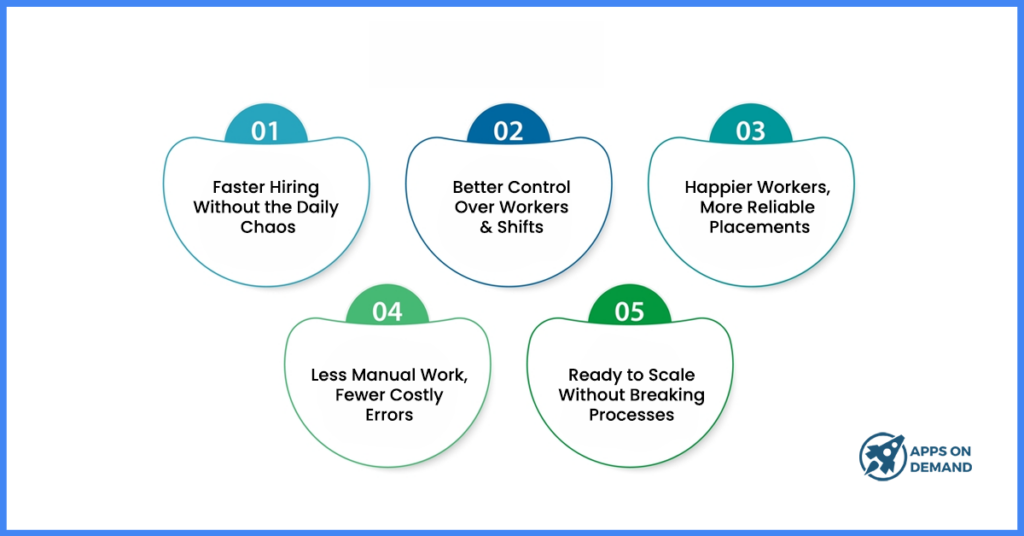
It brings hiring, scheduling, communication, and payments into one system, supporting faster hiring, better control, happier workers, and smoother scaling in 2026.
In real-world deployments, staffing firms using real-time matching and automated notifications consistently report faster confirmations, fewer last-minute cancellations, and higher repeat client usage, especially in high-volume, shift-based industries.
1. Faster Hiring Without the Daily Chaos
In 2026, staffing teams don’t have the luxury of time. Traditional hiring can take 6–8 weeks via agencies or internal ads. But clients want roles filled quickly, and delays cost trust. An on-demand staffing app helps you post requirements instantly, match available workers in real time, and confirm shifts without endless calls or follow-ups.
Instead of reacting to every urgent request, your team works from one system that keeps things moving smoothly, even when demand spikes.
2. Better Control Over Workers and Shifts
Managing availability manually becomes messy as volumes grow. An on-demand workforce app shows you who’s available, where they can work, and when they’re ready, all in real time.
This makes it easier to handle last-minute changes, avoid overbooking, and reduce no-shows. With the right staffing app features in place, you gain clarity instead of constantly firefighting.
3. Happier Workers, More Reliable Placements
Workers stick with platforms that respect their time. When they can choose shifts, get clear job details, and receive payments on time, they’re more likely to show up and keep accepting work.
A good staffing management app creates that experience while reducing coordination work for your team. The result? Better retention, fewer last-minute dropouts, and more dependable staffing delivery.
4. Less Manual Work, Fewer Costly Errors
Spreadsheets, calls, and disconnected tools lead to mistakes, missed shifts, payment delays, and compliance gaps. On-demand staffing app features automate onboarding, time tracking, and payouts, reducing errors and saving hours every week. This is one of the biggest reasons these apps have become must-have tools rather than optional upgrades.
5. Ready to Scale Without Breaking Processes
As your client base grows, so does complexity. An on-demand staffing app helps you handle more clients, more workers, and more locations without increasing operational stress. With centralized data and built-in workflows, scaling becomes manageable instead of overwhelming.
Must-Have Features in On-Demand Staffing Apps for 2026
The key features of an on-demand staffing app are designed to remove friction at every step of the staffing process. It reduces follow-ups, improves transparency, and helps staffing providers deliver consistent results at scale.
In the sections below, we’ll break down the must-have features for on-demand staffing apps in 2026.
1. Easy Job & Shift Creation
In 2026, clients don’t want complicated forms or long calls to explain requirements. They want to post a role or shift in minutes. A must-have on-demand staffing app feature is a clean, intuitive interface where clients can quickly add job details, timing, location, skills, and urgency without needing support every time.
2. Real-Time Talent Matching & Availability
Clients want confidence that their request is being handled immediately. Real-time matching shows them available workers based on skills, location, and past performance. This is one of the key features of an on-demand staffing app because it reassures clients that staffing isn’t stuck in a queue; it’s already in motion.
3. Live Status Updates (No Guesswork)
One of the biggest frustrations for clients is not knowing what’s happening. Modern staffing app features must include live updates, job posted, workers notified, candidate confirmed, and worker checked in. This transparency reduces follow-ups and builds trust without extra communication.
4. Instant Confirmations & Notifications
Once a worker accepts a shift, clients expect instant confirmation. Automated notifications keep them informed without manual coordination. This simple feature dramatically improves the client experience and makes your service feel reliable and professional.
5. Worker Profiles with Skills & Ratings
Clients want to know who they’re getting. Access to worker profiles, skills, certifications, experience, and ratings helps clients feel in control of staffing decisions. In 2026, this level of visibility is expected, especially for enterprise and repeat clients.
6. Flexible Pricing & Cost Visibility
Clients don’t want billing surprises. A strong on-demand staffing app shows clear pricing, shift costs, and invoices upfront. This transparency is one of the must-have features for on-demand staffing apps, especially when managing frequent or high-volume requests.
7. Simple Approvals & Timesheet Visibility
Customers want an easy way to approve hours, track attendance, and flag issues. Built-in timesheet visibility and quick approvals reduce disputes and speed up billing, making life easier for both clients and your internal teams.
8. In-App Communication (Without the Noise)
Instead of juggling calls, emails, and WhatsApp messages, clients prefer one place to communicate. In-app messaging tied to specific jobs or shifts keeps conversations organized and avoids miscommunication.
9. Issue Reporting & Quick Resolution
Problems happen, such as late arrivals, no-shows, or last-minute changes. What matters is how quickly they’re handled. A good on-demand staffing app gives clients a simple way to report issues directly within the app and get fast support. This feature reduces frustration, protects client relationships, and reinforces trust in your staffing service.
10. Easy Re-Booking of Trusted Workers
When a client finds workers they like, they don’t want to start from scratch every time. A smart staffing app allows clients to quickly re-book previously approved or top-rated workers. This saves time, improves worker consistency, and strengthens long-term client relationships, making it one of the most valuable on-demand staffing app features for 2026.
The Tech Stack Behind On-Demand Staffing Apps
When building an on-demand staffing app, technology choices shouldn’t be made in isolation. Every tool in the tech stack exists to support a specific business outcome.
So, instead of thinking in terms of frameworks and tools first, it’s more practical to look at the key on-demand staffing app features and understand the technology that powers them. This approach ensures your on-demand workforce app stays scalable, reliable, and ready for enterprise-level staffing demands.
| Layer | Technology Options | Why It Matters for On-Demand Staffing Apps |
| Frontend (Web) | React.js, Angular, Vue.js | Ensures fast, responsive dashboards for clients and staffing teams using the staffing management app |
| Mobile App | React Native, Flutter, Swift (iOS), Kotlin (Android) | Powers worker and client apps with real-time access to jobs, shifts, and updates |
| Backend | Node.js, Python (Django / FastAPI), Java (Spring Boot) | Handles core logic like job matching, availability, scheduling, and staffing app features |
| Database | PostgreSQL, MySQL, MongoDB | Stores worker profiles, job data, timesheets, compliance records, and transaction history |
| Cloud Infrastructure | AWS, Google Cloud, Microsoft Azure | Provides scalability, high availability, and performance for enterprise-grade on-demand staffing apps |
| AI & ML | Python, TensorFlow, PyTorch | Powers AI features in on-demand staffing applications like smart matching and demand forecasting |
| Payments & Payroll | Stripe, Razorpay, PayPal | Supports secure payments, payouts, and billing within staffing agency technology |
| DevOps & Monitoring | Docker, Kubernetes, CI/CD pipelines | Ensures smooth deployment, scalability, and uptime |
Cost of Developing an On-Demand Staffing App in 2026
Building an on-demand staffing app in 2026 isn’t about building just an app. It’s about choosing the right level of functionality for how your staffing business actually operates today and how you plan to grow.
Costs vary based on app complexity, scale, and the level of automation required, with final pricing influenced by workforce volume, compliance requirements, AI capabilities, and payroll or ERP integrations.
1. Basic MVP App: $30,000 – $50,000
A basic MVP is designed to get you operational quickly without over-engineering. It helps staffing teams move away from spreadsheets, calls, and manual coordination while testing how digital workflows fit into daily operations.
What this typically includes:
- Job and shift creation
- Worker profiles and basic availability tracking
- Shift acceptance and confirmations
- Push notifications and alerts
- Simple admin dashboard
Best suited for:
- Staffing companies launching on-demand services
- Teams validating demand before scaling
- Businesses replacing manual processes
2. Mid-Level, Full-Featured App: $60,000 – $100,000
This is where on-demand staffing apps become a true growth tool. At this level, the platform supports higher volumes, faster placements, and smoother coordination across clients, workers, and internal teams.
What this typically includes:
- Real-time matching and availability
- Advanced scheduling and shift management
- Automated onboarding and document collection
- Time tracking, approvals, and invoicing
- Client, worker, and admin dashboards
- Basic AI features for smarter matching
Best suited for:
- Growing staffing and recruitment companies
- High-volume or short-notice staffing operations
- Providers offering on-demand workforce services at scale
3. Enterprise-Grade Staffing Platform: $120,000 – $200,000+
Enterprise platforms are built for complexity, compliance, and scale. These solutions support multi-location operations, enterprise clients, and advanced reporting while ensuring security and regulatory readiness.
What this typically includes:
- Multi-branch and multi-client management
- Advanced compliance and audit workflows
- Deep analytics and performance reporting
- AI-driven recommendations and demand forecasting
- Integrations with payroll, HR, or ERP systems
- Enterprise-grade security and access controls
Best suited for:
- Large staffing companies
- Providers serving enterprise clients
- Businesses with complex operational requirements
4. Ongoing Maintenance & Support: 15–25% of Development Cost Annually
Launching the app is only part of the investment. Ongoing maintenance ensures the platform stays secure, stable, and aligned with changing business and compliance needs.
Ongoing costs usually cover:
- Cloud hosting and infrastructure
- Security updates and bug fixes
- Feature enhancements and performance tuning
- Third-party API and service fees
- Technical support and monitoring
Challenges in On-Demand Staffing App Development
Building an on-demand staffing app sounds simple on paper, but in reality, it comes with a unique set of challenges. It handles real-time decisions, changing availability, multiple user types, and high expectations from both clients and workers, all at the same time.
This is why understanding the challenges of on-demand staffing app development early on is just as important as choosing the right features.
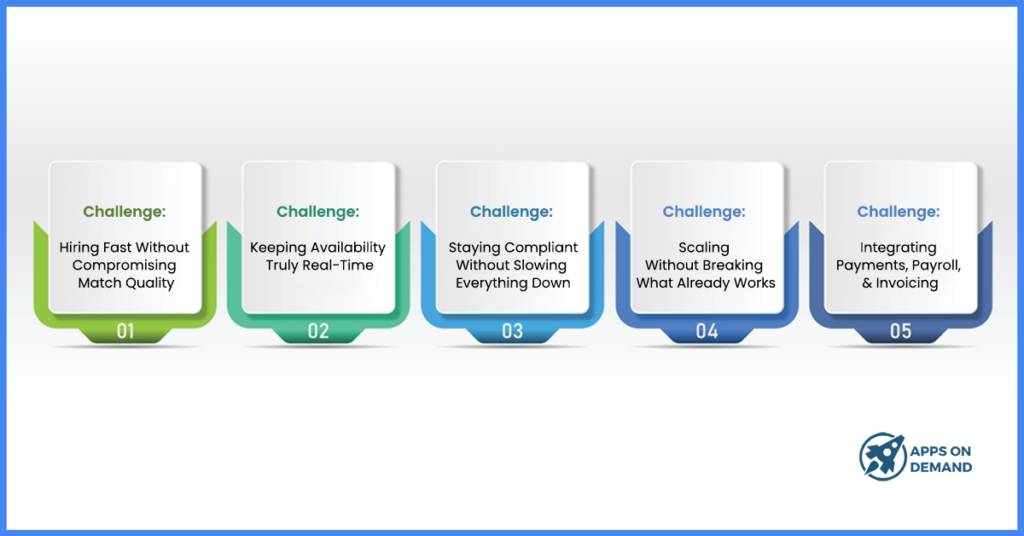
In the section below, we’ll look at the most common challenges staffing providers face when building an on-demand workforce app, along with practical ways to solve them.
1. Challenge: Hiring Fast Without Compromising Match Quality
One of the toughest parts of building an on-demand staffing app is this constant push and pull between speed and quality. Clients want people immediately, but if the match is off, it creates more problems than it solves: drop-offs, replacements, unhappy clients. This is a common issue when on-demand staffing app features focus only on speed.
How it helps:
Smart matching. Not just availability, but skills, location, past performance, and reliability. This is where AI features in on-demand staffing applications make a real difference, helping the app move fast without placing the wrong person in the wrong role.
2. Challenge: Keeping Availability Truly Real-Time
Availability looks simple on paper, but in reality, it’s messy. Workers accept shifts, cancel at the last minute, or forget to update their status. If your on-demand workforce app doesn’t reflect these changes instantly, it leads to double bookings and last-minute chaos.
How it helps:
Real-time updates across the app. Instant confirmations, automatic availability locks, and live status changes reduce manual follow-ups. A strong staffing management app should update availability the moment something changes without anyone chasing anyone.
3. Challenge: Staying Compliant Without Slowing Everything Down
Compliance is one of those things that gets ignored early and becomes painful later. Different clients, roles, and locations all have different rules. If compliance checks slow down hiring, teams start cutting corners, and that’s risky.
How it helps:
Building compliance into the flow. Documents, certifications, and role-specific requirements should be checked automatically inside the on-demand staffing app. This way, hiring stays fast while staying safe.
4. Challenge: Scaling Without Breaking What Already Works
Things often run smoothly at low volume, then start falling apart as demand grows. More clients, more workers, more shifts, and suddenly the system feels slow or unreliable. This is where many on-demand workforce apps struggle.
How it helps:
Building with scale in mind from day one. Cloud-based infrastructure, performance monitoring, and flexible workflows help the app grow without constant firefighting.
5. Challenge: Integrating Payments, Payroll, and Invoicing
Money flows in multiple directions: clients pay invoices, workers get paid, and commissions get tracked. Getting this wrong leads to delays, disputes, and frustration on all sides. Payments are one of the trickiest staffing app features to implement cleanly.
How it helps:
Automated, well-integrated payment systems. Clear timesheets, approval workflows, and transparent billing inside the staffing management app reduce errors and build trust with both clients and workers.
Future Trends of On-Demand Workforce App
1. AI-First Matching Will Become the Default
In 2026 and beyond, AI features in on-demand staffing applications won’t be optional. Apps will rely more on AI to match workers based on skills, past performance, reliability, and real-world outcomes, not just availability. This helps staffing companies improve fill rates while reducing misplacements.
2. Predictive Demand Planning Will Replace Guesswork
Instead of reacting to last-minute requests, on-demand workforce apps will start predicting demand. Using historical data and trends, staffing app features will help teams plan ahead, pre-build talent pools, and prepare for seasonal or recurring spikes.
3. Worker Reuse and Talent Pools Will Matter More
Rather than sourcing new workers every time, on-demand staffing app features will focus on reusing trusted workers. Features like preferred worker pools, rebooking, and performance-based recommendations will become standard, especially for enterprise clients.
4. Enterprise-Ready Features Will Drive Adoption
More large organizations are turning to on-demand staffing models. This means on-demand staffing app features for enterprises, like multi-location management, advanced compliance, and detailed reporting, will become a baseline expectation, not a premium add-on.
5. Worker Experience Will Be a Competitive Advantage
Staffing companies will increasingly compete on worker experience. Flexible scheduling, instant payouts, transparent shift details, and smooth communication inside the staffing management app will directly impact worker retention and reliability.
6. Post-launch Support
As regulations become stricter, staffing agency technology will need to automate compliance even more. Expect on-demand staffing apps to handle document validation, role-based rules, and audit trails automatically without slowing down hiring.
Conclusion
On-demand staffing is no longer about keeping up; it’s about staying relevant. As client expectations rise and workforce dynamics keep shifting, the right on-demand staffing app can make day-to-day operations smoother, faster, and far more predictable.
The difference always comes down to making the right decisions early, what features to build, what technology to rely on, and how to implement it in a way that actually supports real staffing workflows.
That’s where Apps on Demand steps in. We help staffing companies and on-demand workforce providers build solutions that work in the real world, from choosing the right on-demand staffing app features and tech stack to delivering targeted, scalable implementations. Whether you’re starting fresh or upgrading an existing system, our team focuses on building apps that grow with your business.
Looking to connect with our experts or get a free pricing quote? Just reach out to us, and we’ll get back to you.