

Key Highlights
- 52% of users abandon travel bookings before paying, and the right travel booking app features are the only reliable fix.
- AI-powered personalization and smart search filters are no longer differentiators in 2026; they are the baseline expectation for every travel app.
- Platforms like Airbnb, Booking.com, and Hopper have proven that dynamic pricing transparency, real-time booking updates, and ML-based price prediction directly move conversion metrics at scale.
- Travel booking app development costs range from $15,000 for a core app to $300,000+ for an enterprise-grade AI and ML-powered platform with the right app development partner making all the difference in outcome.
52% of travelers abandon due to a bad digital experience
You’ve invested in travel app development. Users download your app, browse destinations, add hotels to cart, and disappear.
The harsh truth? 52% of travelers abandon due to a bad digital experience. That’s not indecision. That’s your app failing to solve critical booking pain points.
When a user reaches checkout and stops, it’s because:
- Prices suddenly changed
- Payment feels insecure
- Search results overwhelmed them
- No instant booking confirmation
This blog reveals exactly how.
You’ll discover the top travel app development features to attract more users, backed by case studies from industry leaders. We’ll cover AI-powered personalization, smart search filters, secure payment integration, real-time booking updates, and must-have features for a travel booking app in 2026 that convert abandoned carts into confirmed trips.
Let’s bridge the gap between downloads and revenue.
The 11 Biggest Booking Pain Points Killing Your Conversions
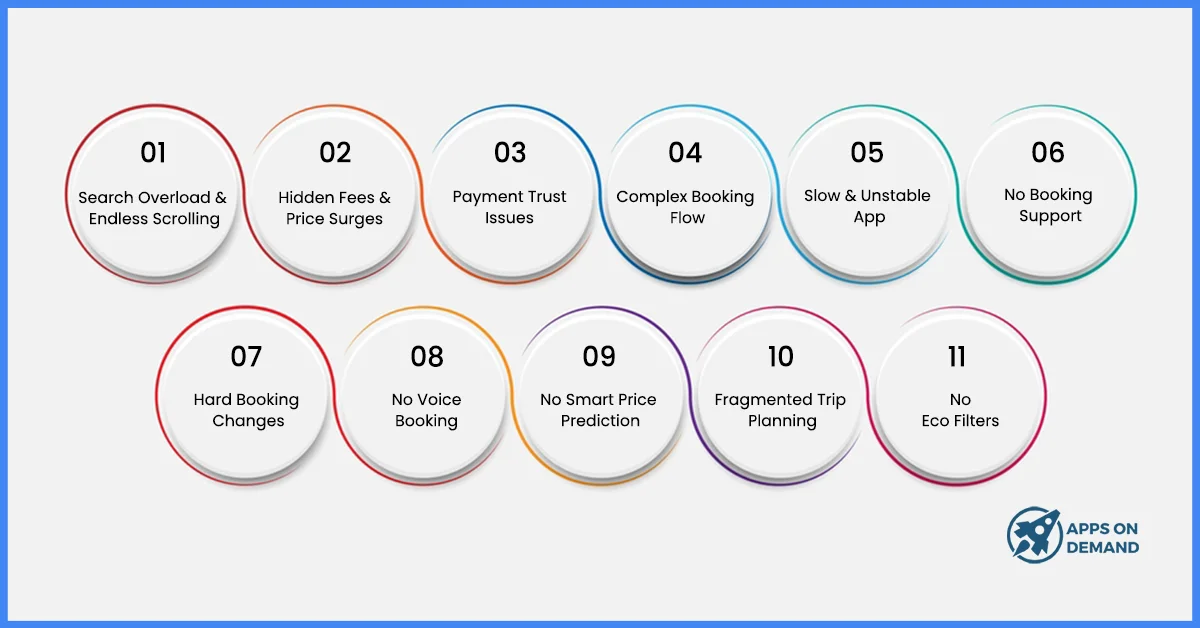
Pain Point #1: Search Overwhelm & Endless Scrolling
What happens: A user searches “hotels in Paris,” gets flooded with 2,847 results, spends 15 minutes scrolling through irrelevant options, and closes the app without booking anything.
The damage: 67% of users abandon when faced with too many unfiltered options, and decision paralysis sets in within just three minutes of scrolling.
Why it happens: Generic search without smart filters and no AI layer to distinguish between a “romantic anniversary trip” and “budget backpacking” leaves users drowning in irrelevant results.
Real user complaint: “I just wanted a hotel near the Eiffel Tower with parking. After 20 minutes of scrolling, I still couldn’t find it.”
Pain Point #2: Sudden Price Jumps & Hidden Fees
What happens: A hotel listed at $120 per night looks like a great deal until checkout reveals the actual total is $178 once taxes, resort fees, service charges, and cleaning fees are added.
The damage: 58% of cart abandonments happen at checkout due to unexpected costs, and this breaks user trust instantly.
Why it happens: Poor dynamic pricing implementation and fees disclosed too late in the booking flow turn a promising booking into an abandoned one.
Real user complaint: “Thought I was getting a $99 deal. Checkout showed $147. Felt like a bait-and-switch scam.”
Pain Point #3: Payment Security Anxiety & Trust Issues
What happens: A user reaches the payment page, finds no trust badges, an unfamiliar payment gateway, and a URL that doesn’t look right, and decides to book directly on the hotel’s website instead.
The damage: 43% of users abandon bookings citing payment security concerns, especially on apps they haven’t used before.
Why it happens: Missing customer trust signals, no visible PCI-DSS compliance badges, and a secure payment integration that doesn’t look credible turn an almost-converted user into a lost one.
Real user complaint: “The payment page looked different from the rest of the app. I wasn’t risking my credit card details.”
Pain Point #4: Complex Multi-Step Booking Funnel
What happens: Booking a flight means navigating a four-page form, entering passenger details repeatedly for each traveler, selecting seats, adding baggage, and then finally reaching payment, by which point most users have already quit.
The damage: Each additional form step reduces conversion by 12%, and the average user abandons at step three of five.
Why it happens: Outdated desktop-first UX design, no smart autofill, and the absence of saved traveler profiles make this process feel exhausting.
Real user complaint: “Had to enter 4 passengers’ passport details manually. By person #3, I gave up.”
Pain Point #5: Slow Loading Times & App Crashes
What happens: A user taps search, watches an eight-second loading spinner, sees images fail to render, and force-closes the app before it freezes completely, opening a competitor’s app instead.
The damage: 53% of mobile users abandon apps that take longer than three seconds to load, and 70% never return after experiencing a crash during the booking process.
Why it happens: Unoptimized hotel photos, heavy API calls running without caching, and poor infrastructure choices in travel booking app development lead to performance collapse under normal usage.
Real user complaint: “App crashed twice while I was entering payment info. Lost all my progress. Deleted immediately.”
Pain Point #6: No Customer Support During Booking
What happens: A user has a specific question about amenities, searches for help inside the app, finds no live chat option, stumbles across a buried email form, and decides to just ask on the hotel’s website.
The damage: 37% of users abandon bookings when they can’t get an immediate answer, and every unanswered question during the booking flow represents a direct conversion loss.
Why it happens: No live chat integration, chatbots that don’t understand context, and support limited to business hours mean that users with questions have nowhere to turn at the moment it matters most.
Real user complaint: “Needed to know if the hotel had an airport shuttle. Couldn’t find info anywhere. Gave up.”
Pain Point #7: Post-Booking Modification Hell
What happens: A user needs to extend their stay by one night, finds no in-app option to do so, calls customer service, waits 45 minutes on hold, and ultimately has to cancel and rebook the entire reservation manually.
The damage: 29% of users never return to an app after a poor post-booking experience, and the lifetime value for those users drops by 68%.
Why it happens: No self-service itinerary management, backend systems not built to support modifications, and inflexible supplier contracts trap users in a painful loop that sends them straight to a competitor.
Real user complaint: “Tried to extend my stay by one night. The app made me cancel the entire booking and start over. Lost my room rate.”
Pain Point #8: No Voice or Conversational Booking Support
What happens: A user tries searching for a hands-free, 4-star hotel in Barcelona next weekend under $150, and the app returns irrelevant results because it simply can’t process natural conversational language.
The damage: Apps without voice and NLP support feel immediately outdated to a fast-growing segment of mobile-first users who expect Alexa-like experiences.
Why it happens: Most travel apps were built on keyword-based architecture, never designed to handle conversational queries.
Real user complaint: Had to type everything in the exact right format.
Pain Point #9: No Real-Time Price Prediction or Smart Booking Timing
What happens: A user books a flight at $340 and watches the price drop to $210 three days later with zero warning, no price alert, and no ML-driven guidance on when to book.
The damage: Users who feel they overpaid migrate to competitors like Hopper or Google Flights that actively use ML-based price prediction to guide booking decisions.
Why it happens: Real-time price prediction requires robust ML models and demand pattern recognition that most travel apps haven’t invested in building.
Real user complaint: “Same seat was $120 cheaper two days later. No alert, no warning. Won’t make that mistake again.”
Pain Point #10: Fragmented Trip Planning With No AI Assistance
What happens: A user planning a five-day Japan trip is forced to search flights, hotels, and activities separately with no intelligent itinerary builder tying everything together.
The damage: Platforms like Google Travel are already offering single-flow AI trip planning, and users who experience the manual alternative on competing apps switch without hesitation.
Why it happens: Most mid-tier travel apps lack the OTA API integration and ML orchestration needed to connect multiple inventory sources into one seamless planning experience.
Real user complaint: “Spent three hours piecing together a week in Japan. Ended up just calling a travel agent.”
Pain Point #11: No Sustainability Filters or Eco-Preference Matching
What happens: A user who only books eco-certified properties finds zero sustainability filters on the app and has to manually research every single listing before making a decision.
The damage: With 76% of travelers wanting to travel more sustainably, apps that ignore eco-preferences are actively alienating a large, fast-growing user segment willing to pay a premium.
Why it happens: Sustainability data isn’t standardized across OTA feeds yet, and most travel app development roadmaps have historically prioritized eco-preference matching over it.
Real user complaint: “No eco filter anywhere. I Google every hotel separately just to check. It’s exhausting.”
Must-Have Travel App Development Features to Attract More Users & Improve Conversions in 2026
Every pain point above isn’t a user problem; it’s a feature gap. Travelers don’t abandon bookings because they changed their minds. They abandon because the app gave them a reason to stop.
Here are the must-have travel app development features that directly fix every friction point covered above, validated by the platforms already converting at scale.
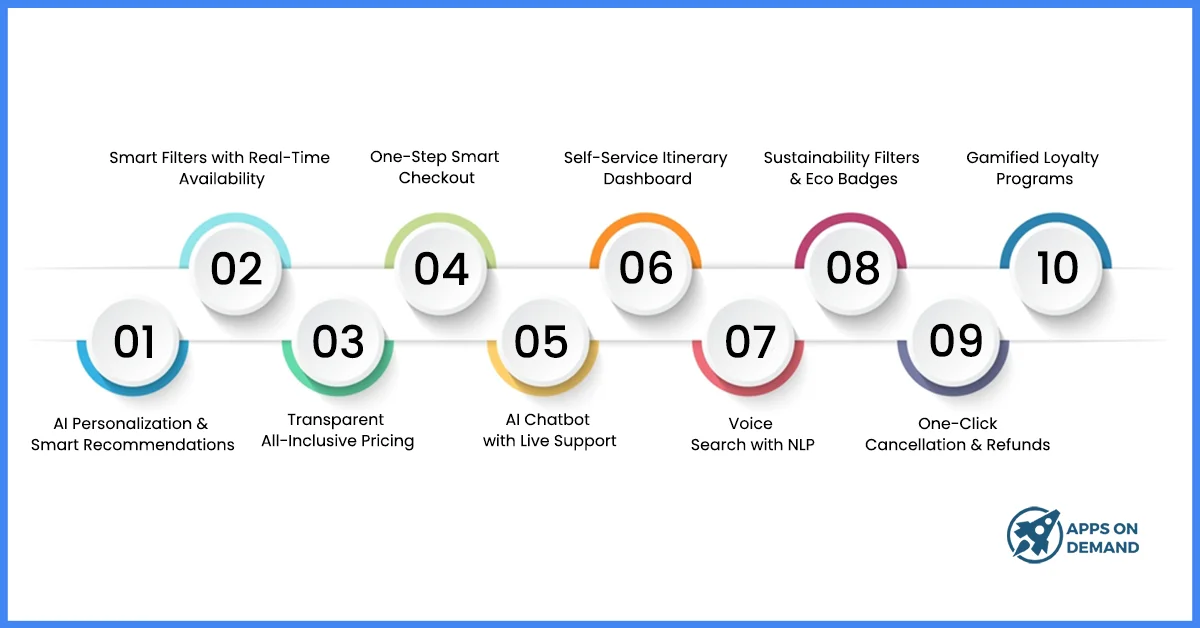
Feature #1: AI-Powered Personalization & Smart Recommendations
Machine learning analyzes user behavior, past searches, booking history, and browsing patterns to serve hyper-relevant suggestions. AI-powered personalization distinguishes “romantic getaway” from “business trip” context, filtering 2,847 generic results into 15-20 perfect matches.
Case Study – Booking.com’s AI personalization engine, analyzing 1.5 billion daily interactions, achieved 30% reduction in search time, 22% increase in conversion rates, and 15% boost in average booking value.
Feature #2: Smart Search Filters with Real-Time Availability
Advanced smart search filters provide granular control: price range sliders, star ratings, guest review scores, specific amenities (pool, gym, parking, pet-friendly), distance from landmarks, neighborhood zones, and eco-certifications.
And, real-time booking updates instantly grey out unavailable properties, ensuring a better customer experience.
Case Study – Airbnb’s filter system redesign reduced average search time from 8.3 minutes to 3.1 minutes, resulting in an 18% conversion rate increase. Their “flexible dates” filter alone drove 23% more bookings during shoulder seasons by showing price calendars highlighting cheaper alternative dates.
Feature #3: Transparent All-Inclusive Pricing Display
Display total price upfront on search results, base rate plus all taxes, resort fees, cleaning charges, and service fees. The breakdown button explains every line item.
- Dynamic pricing transparency shows reasoning: “Price increased 12% due to high demand this weekend.
- Multi-currency support with real-time exchange rates and zero hidden conversion fees.
- Price freeze timers guarantee “This rate is locked for 15 minutes.”
Case Study – Expedia’s shift to all-inclusive pricing transparency reduced cart abandonment by 31%, decreased customer complaints by 42%, and, surprisingly, increased average order value by 8%, as trust built through transparency made users more receptive to legitimate add-ons and upgrades.
Feature #4: One-Step Checkout with Smart Autofill
Condense booking into a single-page checkout. Do it with the smart autofill technology by pulling data from saved traveler profiles and one-click repeat bookings for returning users.
Give them the option of pre-filled payment methods using tokenization, a guest checkout option, and progress indicators.
Case Study – While not travel-specific, Uber’s one-tap booking system revolutionized mobile commerce. Applied to travel booking app development, similar principles show that reducing checkout to one step increases conversion rates by 40-50% compared to traditional multi-step funnels.
Feature #5: AI Chatbot with Live Agent Handoff
Deploy a 24/7 AI chatbot that handles common queries instantly, like “Does this hotel have an airport shuttle?” or “What’s the cancellation policy?” using natural language processing that understands conversational context. When queries become complex, the system seamlessly escalates to live human agents with full conversation history.
Case Study – KLM’s AI chatbot “BB” handles 15,000+ customer conversations weekly across messaging platforms, achieving a 40% resolution rate. Human agent handoff occurs in only 15% of cases, always with the complete conversation context transferred for continuity.
Feature #6: Self-Service Itinerary Management Dashboard
Create a centralized, shareable itinerary management dashboard that consolidates all bookings, flights, hotels, car rentals, and activities with one-click modification capabilities for changing dates, upgrading rooms, or adding travelers without customer service calls.
Case Study – TripIt processes 25+ million trips yearly, with 89% of app store reviews specifically praising the centralized itinerary feature as their primary reason for continued app usage. Also, it boosted the retention rate by 67% and generated 3.2x more bookings annually.
Feature #7: Voice Search with Natural Language Processing
Enable voice-activated search that understands natural conversational queries like “Find pet-friendly beach resorts in Miami under $200 per night with free breakfast”. NLP interprets context, synonyms, and intent while supporting hands-free browsing, with integration into Siri, Google Assistant, and Alexa.
Case Study – Kayak’s voice search feature processes 50,000+ monthly voice queries with 78% accuracy in understanding travel intent. Users who activate voice features show 12% higher engagement and 20% faster booking completion than text-only users.
Feature #8: Sustainability Filters & Eco-Certification Badges
Implement dedicated eco-filters that showcase carbon-neutral properties, LEED certifications, renewable energy usage, waste reduction programs, and local sourcing commitments with visible green badges on property listings. Also, you can include carbon footprint calculators for flights showing emissions and offset purchase options, sustainability scores using a 1-5 leaf rating system.
Case Study – Booking.com’s Travel Sustainable program featuring eco-badges and sustainability filters now covers 400,000+ properties globally and have 20% higher booking rates from eco-conscious travelers, along with 12% premium pricing tolerance.
Feature #9: Flexible Cancellation with One-Click Refunds
Display free cancellation badges prominently in search results with clear refund timelines using visual countdown timers like “Cancel by Feb 15, 11:59 PM for full refund. 14 days remaining.”
Offer multiple cancellation tiers with comparison tables showing full refund, partial refund, and non-refundable options, while enabling one-click cancellation and instant refund processing to the original payment method within 3-5 business days maximum.
Case Study – Agoda’s comprehensive data analysis revealed that properties offering free cancellation see 24% higher booking rates even when priced 8% higher than non-refundable options, definitively proving that flexibility drives conversions more powerfully than price alone.
Feature #10: Loyalty Programs with Gamification
Create a points system earning on every booking that’s redeemable for discounts or free nights, tier levels like Silver, Gold, and Platinum unlocking exclusive perks including room upgrades and late checkout, streak bonuses encouraging consistent booking patterns, and achievement badges like “Weekend Warrior” or “Global Explorer” with progress bars visualizing advancement toward the next tier.
Case Study – Hotels.com’s “Book 10 nights, get 1 free” loyalty program drove a 55% increase in repeat bookings, 2.8x higher customer lifetime value compared to non-members, and 34% growth in direct app downloads as satisfied members actively promoted the program.
How Much Does a Travel App Cost to Develop?
Travel app development costs range from $15,000 for a basic booking app to $300,000+ for an enterprise-grade platform with AI-powered personalization, OTA API integration, and ML-based price prediction built in.
The more must-have travel app features you prioritize, such as smart search filters, real-time booking updates, dynamic pricing, and multi-currency support, the higher the investment. Choosing a development partner in India or Eastern Europe can reduce costs by 40–60% without compromising quality.
| App Type | Key Features Included | Estimated Cost | Timeline |
| Basic Travel App | Search, listings, booking flow, secure payment integration | $15,000 – $30,000 | 3–5 months |
| Mid-Tier Travel Booking App | Smart search filters, multi-currency support, itinerary management, and real-time booking updates | $30,000 – $80,000 | 5–8 months |
| Advanced Travel App | AI-powered personalization, ML-based price prediction, OTA API integration, voice search, dynamic pricing | $80,000 – $150,000 | 8–12 months |
| Enterprise-Grade Platform | Full AI trip planning, sustainability filters, PCI-DSS compliance, live support, custom OTA API integration | $150,000 – $300,000+ | 12–18 months |
Final Thoughts
The platforms winning in 2026 aren’t winning because they have bigger marketing budgets. They’re winning because they invested in the right travel booking app features, AI-powered personalization that understands intent, dynamic pricing that builds trust instead of breaking it, real-time booking updates that eliminate post-payment anxiety, and itinerary management that makes the entire journey feel effortless from search to check-in.
The good news is that none of this is out of reach.
But what separates the apps that get it right from the ones that don’t is usually the team behind the product and the people who understand not just the technology, but the specific demands of the travel industry and the behavior of travelers at every stage of the booking funnel.
At Apps On Demand, that’s exactly what we bring to every project. Our team of expert app developers has deep experience building AI and ML-powered travel apps that are designed from the ground up to reduce abandonment, improve retention, and convert browsers into bookers. If you’re planning to build or scale a feature-rich travel booking app, we’re happy to help you think it through.